Antek returns home and recommits to the farm
The PeasantsAntek Boryna’s return to Lipce is at once a family reunion and a recommitment to the land: after meeting Hanka Borynowa and embracing their children, he walks among the fields and resolves to stay, take up the work handed down by earlier generations, and pass it on to his son. The homecoming moves from bodily emotion to practical attention and finally to moral reckoning, making return less a simple arrival than a decision to re-enter a demanding way of life.
The news and the reunion
The news reaches Hanka while she is away from the farm, working with a mattock. Józka Borynianka comes hurrying along the river path between the reeds and young alders, waving her arms and calling, “Hanuś! Antek’s back! Hanuś!” Hanka drops the tool and runs, then catches herself: she lets down her hitched-up woollen skirt and tries to speak calmly, though her heart is pounding and she can barely catch her breath. The quick correction gives the moment its particular tension. Her joy is immediate, but she attempts to compose herself before facing the man whose return has overwhelmed her.
Józka explains that Antek arrived and asked for Hanka as soon as he reached the doorstep. That detail intensifies Hanka’s happiness: he has not merely come back to the village; he has asked for her. When she reaches the farmyard, Antek is sitting on the porch with Rocho. He sees her and comes to meet her. Hanka’s approach slows as her legs buckle; she grips the fence for support, choked by tears and unable to find words beyond “It’s you! It’s you!” Antek answers, “It’s me, Hanuś! It’s me!” and holds her close. The reunion is conveyed through the physical difficulty of standing, breathing, speaking, and finally embracing. Their mutual affection becomes legible before either can explain it.
A family gathered again
The homecoming also brings Antek face to face with the children who have grown in his absence. Hanka brings out the younger boy, who is crying, and compares his likeness to his father. Antek wraps the child in a corner of his capote and rocks him. Hanka introduces him as Rocho and calls the older boy, Pietruś, forward. Pietruś climbs onto his father’s knee, and Antek embraces both boys with a tenderness that surprises even in its intensity. His affectionate attention to them gives the reunion a future as well as a past: the family is not only restored around the returning father but gathered around children who have continued to grow without him.
The details Hanka shares are ordinary and intimate. Pietruś has grown and talks; he is lively, quick-witted, and fond of cracking a whip and chasing the geese. Antek listens and responds warmly to the children. Their exchange contrasts with the overwhelming emotion of his first meeting with Hanka: here, belonging takes the form of names, gestures, growth, and small habits. The return is made real not only by an embrace but by Antek’s recognition of the household life that has carried on in his absence.
The fields and the decision to stay
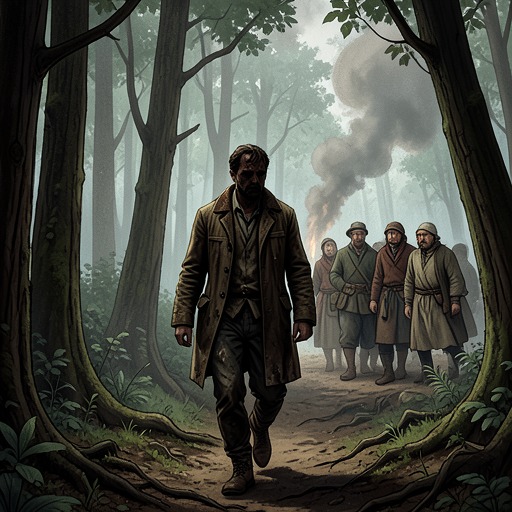
Antek soon turns from the household to the land. On the fields beyond the village, almost all of which are planted with winter wheat that year, he meets few people. He greets those he does encounter briefly and continues along the baulk with Pietruś growing heavier in his arms. The walk slows him down. He stops, crouches, and examines the strips one by one, noticing that quickweed is choking the flax and that the barley looks weak and scorched beneath thorns, chamomile, and sorrel. His return is therefore tested against the actual condition of the farm: the fields are not an abstract inheritance but work requiring close attention, judgment, and repair.
As he surveys the crops, Antek feels himself back on his father’s and grandfathers’ fields, among his own people. His response is so powerful that he imagines kneeling to the earth and embracing the world; he tries to attribute his tears to the air, but cannot suppress the happiness that has overtaken him. The land gives his homecoming its deepest meaning. He declares inwardly, “See, I’m back! I’m back and I’m staying!” The decision is not simply to reside again in Lipce. It is to accept the labour and continuity attached to the fields.
Inheritance, labour, and self-judgment
Antek understands the life he is choosing as a succession across generations. He prepares to shoulder the heavy work as his father did before him, with his grandfathers and great-grandfathers before that, until Pietruś in turn takes up the burden. He frames this continuity as a submission to divine will: “Young after old, son after father, in turn, for ever, while it be your will, merciful Jesus.” The phrase joins inheritance to obligation. Land gives Antek a place among his forebears, but that belonging carries work that cannot be set aside or completed by one generation alone.
The return also leads him inward. Resting his head in his hands, Antek is assailed by memories and by a stern voice of conscience. He bows before it and examines his dealings, acknowledging sins and offences. Contrition does not come easily: he has to overcome arrogance and pride before judging his own conduct with severity. The passage does not specify each matter he reviews, but it makes clear that recommitment involves more than taking up farm labour. His return brings him back to the family and fields while forcing him to confront the life he has lived. The decisive movement is from the joy of arrival to the harder resolve to stay, work, and reckon with himself.